

Standard electrode potential
- Part I: Review of Redox Reaction · Galvanic Cells and Electrolytic Cells
- Part II: Definition of Standard Electrode Potential
Part I: Review of Redox Reaction · Galvanic Cells and Electrolytic Cells
· Redox reaction
Redox reactions are chemical reactions in which electron gain or loss occurs.
We can split the redox reaction above into the following two half-reactions:
One is a reduction reaction where Ox1, the oxidized state of substance 1, gains electrons to reduce to Red1, the reduced state of substance 1 . The other is an oxidation reaction where the reduced state Red2 of substance 2 loses electrons and oxidizes to the oxidized state Ox2 of substance 2 Oxidation and Reduction reactions necessarily occur in pairs, and the half reactions cannot exist separately.
For redox reactions in which n electron transfers occur can be expressed in general terms as reduction half-reactions and oxidation half-reactions in Eqs. 2 and 3.
· Galvanic Cells and Electrolytic Cells
Primary cell is a device that converts chemical energy directly into electrical energy through a redox reaction, while an electrolytic cell is a device that converts electrical energy directly into chemical energy through an electrolysis reaction.
Electrolysis is the process of controlling the potential or current on the electrodes through an external power supply device, so that the two electrodes in the electrolyte solution have a potential difference (anode, cathode), and the oxidation-reduction reaction occurs respectively is called electrolysis.
Here is a comparison of Figures 1 and 2 to further our understanding of primary cells and electrolytic cells.
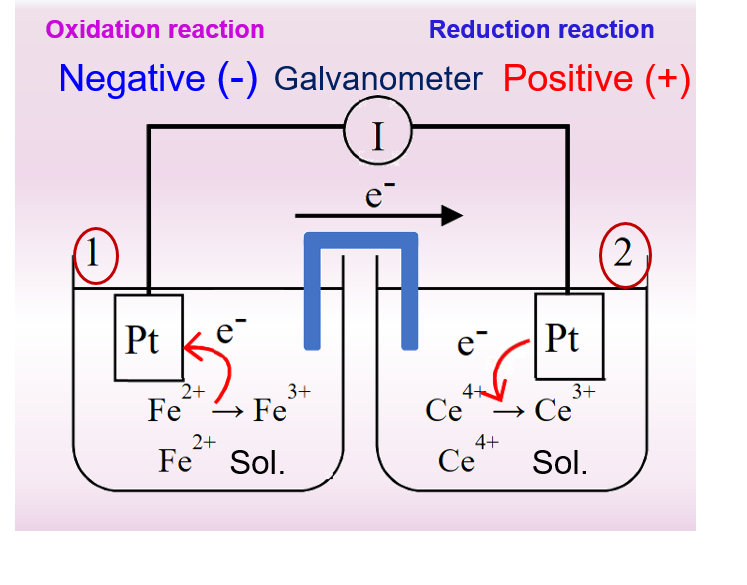
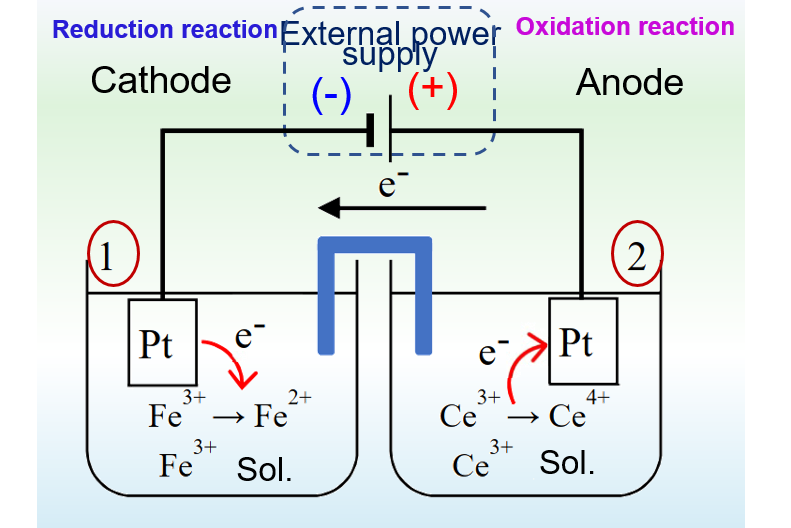
A primary cell consisting of an electric pair of iron ions and cerium ions is represented in Fig. 1 on the left. It can be seen that a spontaneous reduction reaction occurs at the positive electrode, i.e., the tetravalent cerium ion gains an electron and is reduced to a trivalent cerium ion, while an oxidation reaction occurs at the negative electrode, i.e., the Fe2+ ion loses an electron and is oxidized to a Fe3+ ion. Note that the two platinum electrodes in this primary cell do not participate in the electrode reaction only as a carrier for electron conduction.
For the electrolytic cell in Fig. 2, the electrode connected to the positive pole of the external power supply is the anode, where an oxidation reaction occurs and Ce3+ is oxidized to Ce4+. The electrode connected to the negative pole of the external power source is the cathode, where a reduction reaction occurs and Fe3+ ions are reduced to Fe2+ ions.
The electrode reactions in the primary cell of Fig. 1 and the electrolytic cell of Fig. 2 are inverse to each other. The primary cell works as a discharging process, while the electrolytic cell works as a charging process.
For the primary cell in Fig. 1, the overall cell reaction can be expressed as equation (4)
Following the convention to represent half-cell reactions, uniformly, in the form of reducing half-reactions, then the protocell reaction of Fig. 1 is composed of the two half-cell reactions of Eqs. (5) and (6).
If equation 6 is subtracted from equation 5, the electron e is eliminated, and then after shifting the terms, the same chemical reaction formula as equation 4 can be obtained. Similarly, the potential difference between the positive and negative terminals of the battery, that is, the electric potential of the battery, can be expressed as Right half-reaction potential (E2) minus Left half-reaction potential (E1)

The question then is, how is the electrode potential of the half-reaction obtained here? As mentioned earlier, the potential of the half-reaction, i.e. the potential of a single electrode, cannot be measured alone. Therefore, in practice, the potential of the reduced half-reaction can only be obtained by measuring the potential difference between the single electrode and the reference electrode (the electrode used as a reference).
Part II: Definition of Standard Electrode Potential
The standard hydrogen electrode (SHE, standard hydrogen electrode) is usually used as the reference electrode. Its electrode potential is defined as ESHE = 0 V.
The potential difference measured with ESHE as the reference electrode is defined as: electrode potential
The potential difference under standard conditions is defined as: standard electrode potential (Eo, standard electrode potential)
Eo Ce3+/Ce4+ = 1.61V → is the standard potential difference of Ce4+/Ce3+ relative to SHE under standard conditions (Fig. 2-1)
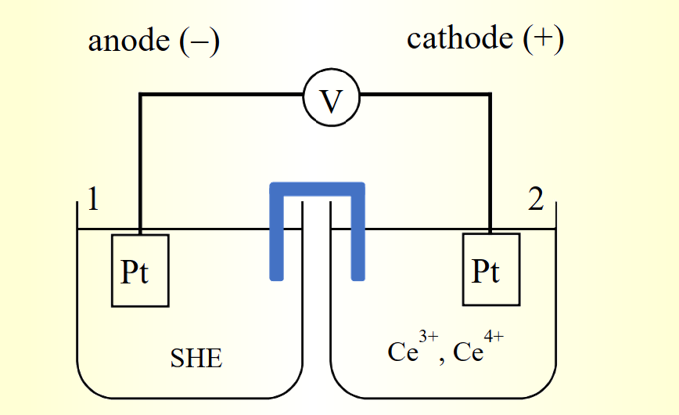
Fig. 2-1 Potential relative to SHE
If the primary cell in Fig. 1-1 is connected to an external circuit, electrons will flow from the left half-cell (1) to the right half-cell (2) through the external circuit, indicating that the right half-cell (2) is more likely to accept electrons.Therefore, the electrode potential is an indicator of how easily a substance accepts electrons. A system with a higher electrode potential is more likely to accept electrons (i.e., it is more likely to be reduced).
The standard cell electromotive force of the middle primary cell of Fig. 1-2 can be calculated as follows to be 0.84 V.

According to the writing method of the primary battery we introduced in the first article: the positive electrode is generally written on the right and the negative electrode is written on the left.
The battery in Fig. 2-1 can be represented as follows: Negative electrode | Solution 1 || Solution 2 | Positive electrode (a single vertical line | represents the interface between the two phases; a double vertical line || represents the salt bridge connection between the two liquid phase interfaces)
Understanding the meaning of the magnitude of the positive and negative values of the electrode potential is useful in the future for designing and determining the direction in which a redox reaction proceeds:
The larger the positive value of the electrode potential E: the stronger the oxidizing substance is (the oxidizing substance is easily reduced).
The larger the negative value of the electrode potential E, the stronger the reducing agent is (the reducing agent is easily oxidized).
When two half-cells are connected to form a battery, the electric potential of the battery is positive when the right side is positive (reduction reaction) and the left side is negative (oxidation reaction).
Ecell = E right - Eleft < 0
For the above mentioned primary battery, the tetravalent cerium ion is a stronger oxidant, and the divalent iron ion is a stronger reducing agent. The redox reaction of the cell is usually a reaction between the stronger oxidizing agent and the stronger reducing agent to form a weaker reducing agent and a weaker oxidizing agent.
Consider first the following reaction example of equation (7). A silver chloride solid gains an electron, reduces to a silver atom and releases a chloride ion.
This one is usually called the reaction at the silver/silver chloride electrode. The s and aq in parentheses represent the solid state and the state dissolved in water, respectively. Since, the potential of the half-reaction cannot be measured separately, to measure the potential of the silver/silver chloride electrode, choose to use the hydrogen electrode reaction as the reference standard of the electrode potential, and obtain the electrode potential of the silver-silver chloride electrode by forming a Harned cell as shown in Fig. 2-3.
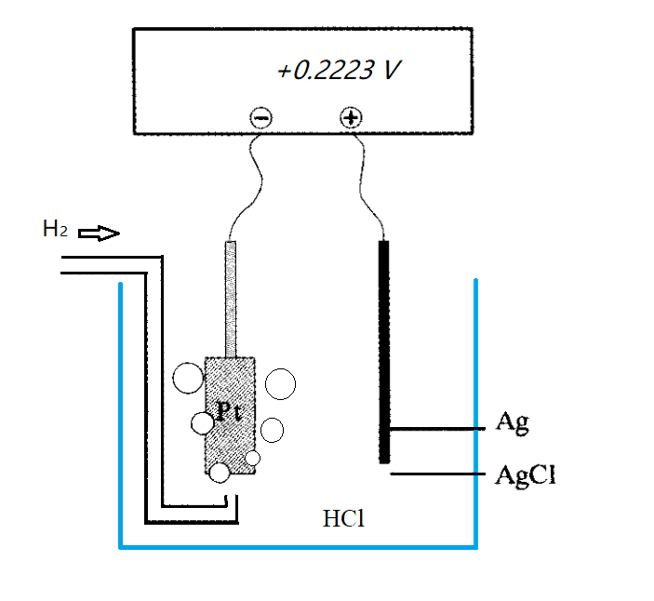
Fig. 2-3 Schematic diagram of Harned cell electric potential measurement};
The reaction equation of the hydrogen electrode is expressed by equation (8).
This battery can be simply represented as:
Here, the vertical line Ι represents the interface between two different phases. The Cu at each end indicates the copper conductor between the electrode and the potentiostat. It has been agreed that when the cell equation is written in the above manner, the electric potential E is determined as the potential of the conductor to which the right electrode is connected, minus the potential of the conductor of the left electrode (this has been specified to enable this to be done).~
The overall reaction of the battery is a combination of equations (7) and (8), and the battery electromotive force E can be expressed by equation (9).

(9)
Or it can be expressed more simply as
Eo(AgCl/Ag) = 0.2223 V[1]
(11)
The standard electrode potential discussed is the electric potential of a Harned cell as shown by the substances involved in the cell reaction in the standard state, here denoted by Eo. The values of the standard electrode potential for silver chloride electrodes are listed in literature [1].
Reference
[1] A. J. Bard, R. Parsons, and J. Jordan, Stand Potenrials in Aqueous Solution, Marcel Dekker, New York (1985).